TL;DR
Ramadan 2027 (1448 AH) is expected to begin on Monday, February 8, 2027, with the first taraweeh on the night of February 7; countries relying on local moon sighting may start February 9. Eid al-Fitr is expected on Tuesday, March 9 or Wednesday, March 10, and the 27th night begins at sunset on Friday, March 5.
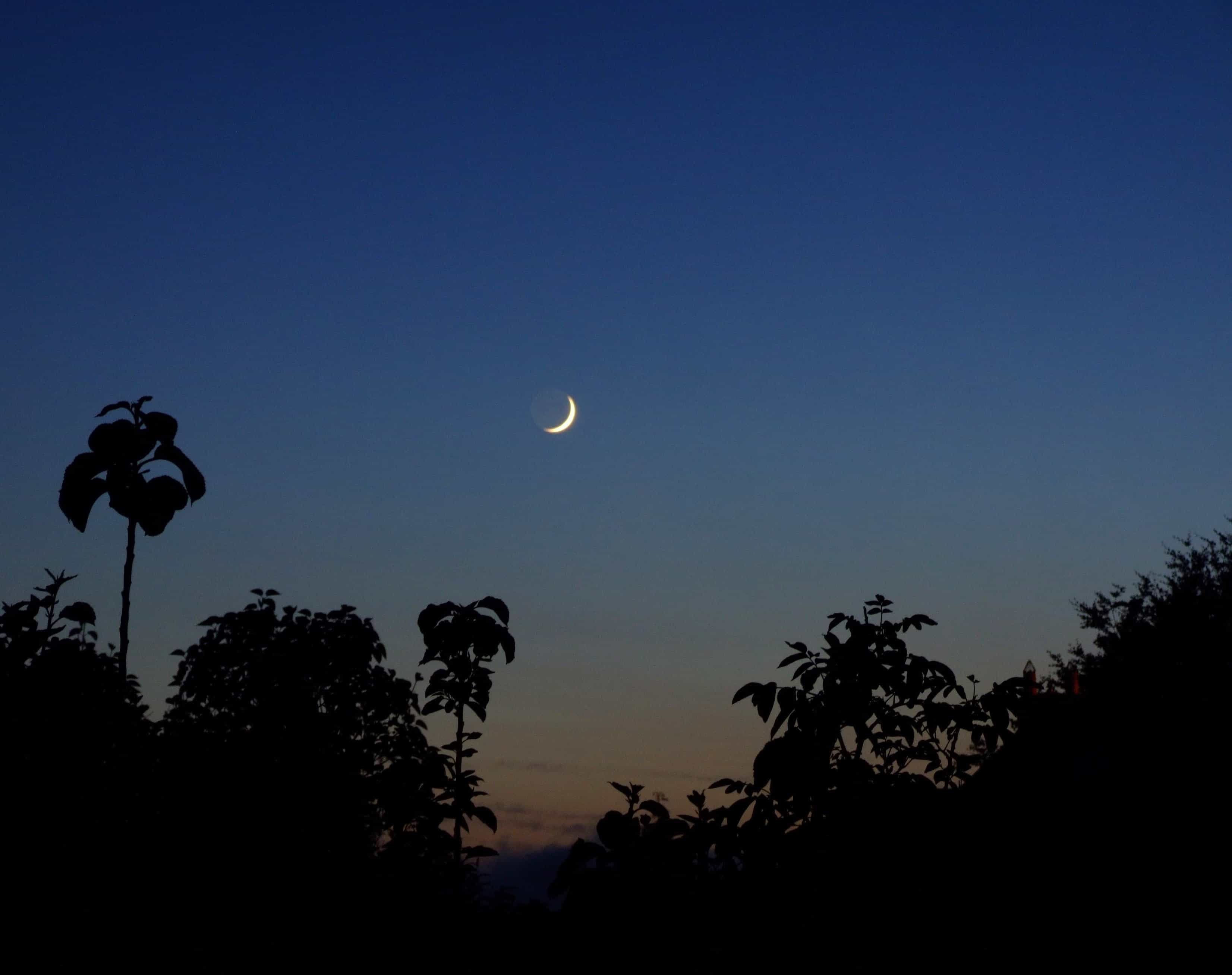
The dates above come from astronomical calculation: the new moon (conjunction) falls on Saturday, February 6, 2027 at 15:56 UTC, too late for the crescent to be seen that evening, so the first sighting is expected on the evening of February 7. The official Ramadan 2027 start date in your country is still set by local moon sighting (hilal, رؤية الهلال), which can shift it by a day.
Ramadan 2027 Calendar — Quick Reference
| Event | Expected date |
|---|---|
| Crescent sighting evening (29 Sha'ban) | Sunday, February 7, 2027 |
| First taraweeh | Night of Sunday, February 7 |
| 1st day of fasting | Monday, February 8, 2027 |
| Last ten nights begin | Evening of Saturday, February 27 |
| Laylat al-Qadr (27th night) | Evening of Friday, March 5 |
| Shawwal crescent sighting evening | Monday, March 8, 2027 |
| Eid al-Fitr | Tuesday, March 9 or Wednesday, March 10, 2027 |
| Length | 29 or 30 days (confirmed by moon sighting) |
The Shawwal new moon falls on March 8 at 09:29 UTC. In most of the world the crescent will be very young at sunset that evening, which is why Eid may land on March 10 rather than March 9 in countries that need a clear sighting.
Ramadan 2027 Dates by Country
A one-day difference between countries is normal. It comes from whether a country uses a calculated calendar, its own moon sighting, or follows another country's announcement.
🇸🇦 Saudi Arabia
The Supreme Court announces the start after the sighting session on the evening of 29 Sha'ban. Expected first fast: Monday, February 8, 2027.
🇦🇪 UAE, 🇶🇦 Qatar, 🇰🇼 Kuwait, 🇧🇭 Bahrain
Gulf moon-sighting committees usually match Saudi Arabia. Expected first fast: February 8, 2027.
🇪🇬 Egypt
Dar al-Ifta combines astronomical calculation with sighting. Expected first fast: February 8, 2027.
🇹🇷 Turkey
Diyanet uses a calculated calendar published in advance. Expected first fast: February 8, 2027.
🇲🇾 Malaysia & 🇮🇩 Indonesia
JAKIM and Indonesia's Ministry of Religious Affairs hold their own sightings. Expected first fast: February 8–9, 2027.
🇵🇰 Pakistan & 🇮🇳 India
The Central Ruet-e-Hilal Committee (Pakistan) and local committees in India rely on local sighting and often start a day after the Gulf. Expected first fast: February 8–9, 2027.
🇬🇧 United Kingdom & 🇺🇸 United States
Mosques follow either local sighting, calculation (the Fiqh Council of North America uses a calculated calendar), or the Saudi announcement. Expected first fast: February 8, 2027. Check with your local masjid.
Bottom line: plan for Monday, February 8 as day one, keep February 9 as a possible alternative, and confirm when your local authority announces on the evening of February 7.
The Last Ten Nights and Laylat al-Qadr 2027
The Prophet ﷺ said: "Seek Laylat al-Qadr in the odd nights of the last ten nights of Ramadan" (Sahih al-Bukhari 2017). An Islamic night begins at sunset, so each odd night starts on the evening before the matching day of fasting.
| Night | Begins at sunset on (if Ramadan starts Feb 8) |
|---|---|
| 21st | Saturday, February 27 |
| 23rd | Monday, March 1 |
| 25th | Wednesday, March 3 |
| 27th | Friday, March 5 |
| 29th | Sunday, March 7 |
If your country starts Ramadan on February 9, move each date one day later. For what the night means, its signs, and how to spend it, read our full guide to Laylat al-Qadr — the night worth a thousand months.
A Khatm Plan for Ramadan 2027
The standard Madani mushaf has 604 pages in 30 juz. To finish the whole Quran in Ramadan:
| Ramadan length | Pages per day | Roughly |
|---|---|---|
| 30 days | 20.1 | 1 juz a day |
| 29 days | 20.8 | 1 juz + 1 page |
| Finish by the 27th night (26 days) | 23.2 | 1 juz + 3 pages |
Split it across the five prayers and it becomes about 4 pages after each salah — ten minutes at a steady pace. Want a different target, like two khatms or finishing by the 27th night? Use the free Quran khatam calculator to get your exact pages per day and finish date, or follow the day-by-day Ramadan Quran plan for all 30 juz.
Start in Sha'ban, not on day one
The most common reason a Ramadan khatm fails is not the pace — it is starting cold. The four months before Ramadan are the time to build the daily habit, so that on February 8 you are adding pages to a routine you already have, not trying to start one while fasting.
Want company for your khatm? Join the Ramadan Khatm circle: one juz a day from Monday 8 February 2027, read together with Muslims worldwide, with the full Ramadan 2027 Quran reading schedule by date. For the last ten nights there is a separate nightly du'a circle.
How Quran Gate Keeps Your Ramadan Reading on Track
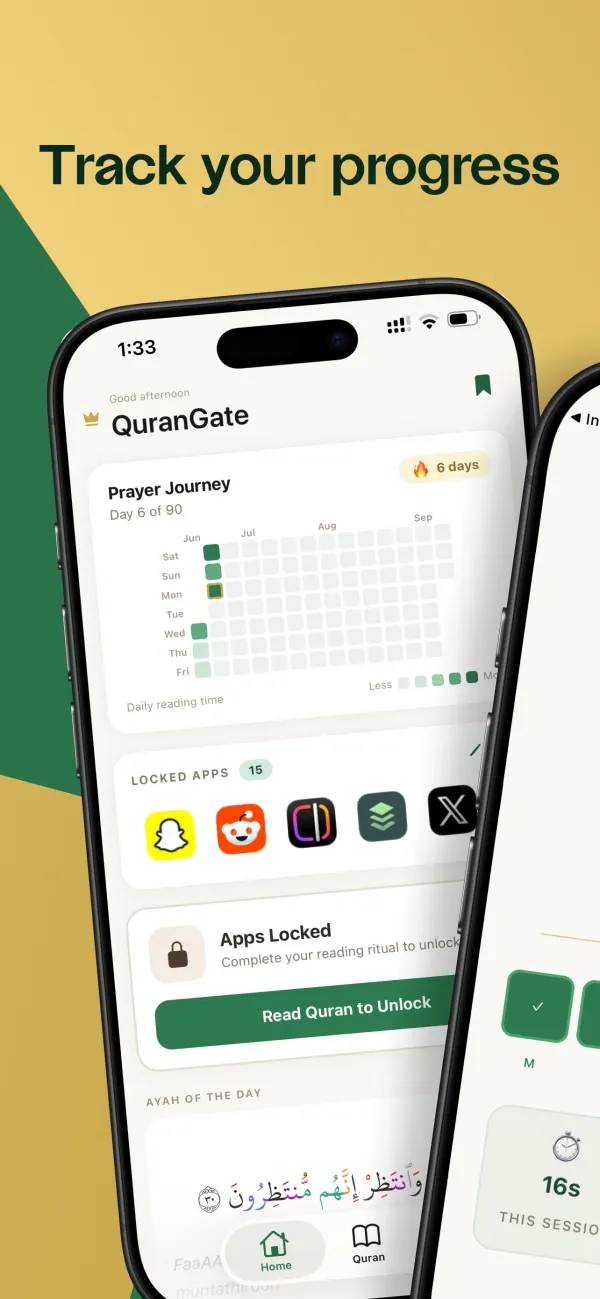
Most Ramadan reading plans lose to the phone around the middle of the month: a quick look at Instagram after iftar turns into an hour. Quran Gate turns that moment around. You choose the apps that pull you in — Instagram, TikTok, YouTube, games — and once your time limit runs out they stay locked until you read your Quran portion.
- Picks up exactly where you left off. Your reading moves sequentially through the mushaf, so every unlock is progress toward your khatm, not a random verse.
- Set your daily goal from half a page up to three pages per ritual, and read more in the full reader whenever you want.
- Listen and follow along with 6 renowned reciters, with each word highlighted as it is recited — useful for taraweeh preparation and for correcting your recitation.
- Tajweed-coloured Uthmanic text with 16 translations in 11 languages and a transliteration toggle.
- Streaks, a 90-day heatmap and a dashboard calendar that show every day you read, so a missed day is visible, not forgotten.
- Keeps going after Eid. The same structure that carries you through Ramadan keeps working in Shawwal and beyond — see how to keep your Quran habit after Ramadan.
The free plan blocks one app; Premium blocks unlimited apps, categories and websites with a 7-day free trial, and one subscription covers your whole family. No ads.


Related reading:
- Ramadan Quran Plan — How to Complete All 30 Juz
- Laylat al-Qadr — The Night Worth a Thousand Months
- Building a Quran Habit After Ramadan Ends
- 7 Best Apps for Reading Quran in 2026
Dates in this guide are astronomical estimates as of September 2026. Always confirm the Ramadan 2027 start date with your local mosque or national Islamic authority after the moon-sighting announcement.
Frequently Asked Questions
When does Ramadan 2027 start?
Ramadan 2027 (1448 AH) is expected to begin on Monday, February 8, 2027, with the first taraweeh prayer on the night of Sunday, February 7. Countries that rely on local moon sighting may start a day later, on February 9. Confirm with your local mosque or national authority.
When is Eid al-Fitr 2027?
Eid al-Fitr 2027 is expected on Tuesday, March 9 or Wednesday, March 10, 2027, depending on whether the Shawwal crescent is sighted on the evening of March 8.
When is Laylat al-Qadr 2027?
Laylat al-Qadr falls in the last ten nights of Ramadan, most likely on an odd night. If Ramadan starts on February 8, 2027, the odd nights begin on the evenings of February 27 (21st), March 1 (23rd), March 3 (25th), March 5 (27th) and March 7 (29th).
How many pages a day do I need to finish the Quran in Ramadan 2027?
The standard Madani mushaf has 604 pages, so finishing in 30 days takes about 20 pages a day — roughly one juz. If Ramadan is 29 days, it is about 21 pages a day. The khatam calculator works out other targets.
Why does Ramadan start earlier every year?
The Islamic calendar is lunar, about 354 days long, while the Gregorian calendar is 365 days. Ramadan therefore moves about 10 to 11 days earlier each Gregorian year: it began around February 18 in 2026 and is expected around February 8 in 2027.
Will 2027 have two Ramadans?
No. Ramadan 2027 is expected to begin around February 8, and the following Ramadan around January 28, 2028, so 2027 contains only one. Because the Islamic year is about 11 days shorter than the Gregorian year, two Ramadans fall in the same Gregorian year only occasionally; the next time is 2030.
